via The Conductor's Notebook. View Original
Sunday, October 11, 2015

Thursday, February 19, 2015
jordanconductor: I would not be a musician today if it weren’t...

I would not be a musician today if it weren’t for the overwhelming influence of my high school band director. This man was unique for the outstanding degree of musicianship he imparted to suburban 16-year-olds every day, yet he was more for being a veritable Titan of compassion. You have left your mark on the world. Rest in Peace, Gary Faust.
via The Conductor's Notebook. View Original
Wednesday, September 3, 2014
jordanconductor: Worthy of consideration: What’s Lost When the...

jordanconductor: Worthy of consideration:
What’s Lost When the Cloud Replaces CDs
newyorker.comRecently, while moving my CD collection to new shelving, I struggled with feelings of obsolescence and futility. Why bother with space-devouring, planet-harming plastic objects when so much music can …
via The Conductor's Notebook. View Original
Tuesday, September 2, 2014
Morning Insights from the Essay du Jour
Universities and Symphonies alike are constantly looking for an essay or document in the application process and the prompt I’m writing against this morning (source link below) emphasizes diversity.
It occurs to me that programming practices and repertoire studies in the US cannot help but present a barrier to repertoire diversity, as masterworks are emphasized year over year rather than exposure to international genres. That’s not to say that masterworks should not continue to be studied, but there must be a structure for ensuring that a variety of cultures are represented. More to come on this topic.
via The Conductor's Notebook. View Original
Thursday, May 15, 2014
Performance Design: Beyond Interpretation
I am currently working on a concept I call Performance Design. It’s an idea that builds on top of the art of interpretation and takes into consideration the many other layers of performance with which performers seem not to generally concern themselves. This includes considering audience perception, which I believe is perhaps the single most fruitful plain that we as musicians regularly fail to cultivate. It also considers a range of alternate ways to look at programming, venue selection, and even marketing and recording. Here’s a short excerpt of a larger paper (perhaps one day a book) I'm writing on the topic:
Interpretation is a commonly understood term among musicians, a term denoting the “stylistic representation of a creative work." However, interpretation is often wrongly believed to be a self-consistent and complete toolset for preparing the score for performance. Rather than merely augment the accepted definition of interpretation, I propose that a new term must be used to represent the superset of tools valuable to the performer, of which the traditional methods of interpretation are a subset.
I argue for the use of the term Performance Design (PD) to indicate the totality of means and methods by which live concert performances are planned and prepared. Included in these means are tools from Neuroscience, Information Theory, and other audience-centric disciplines.
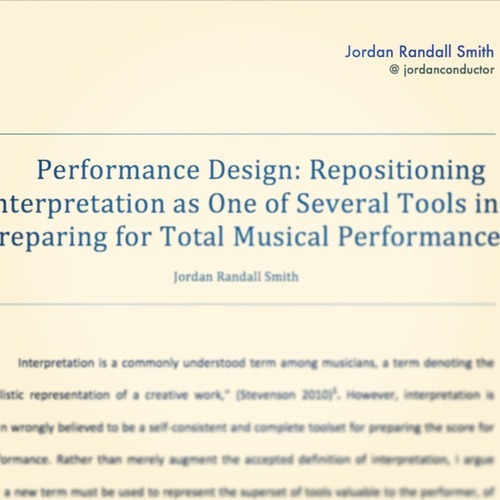 |
| "Performance Desing: Repositioning Interpretation as One of Several Tools in Preparing for Total Musical Performance" by Jordan Randall Smith |
Saturday, May 10, 2014
iTunes Release
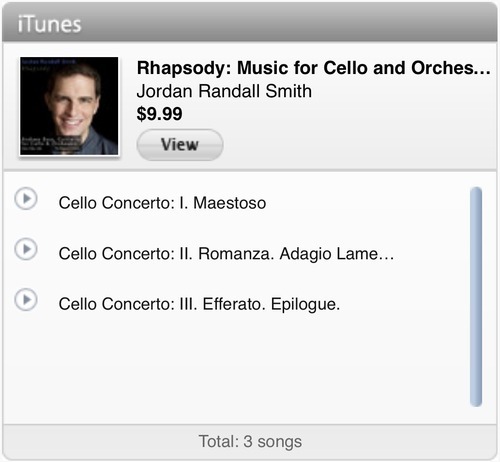
I’m excited to announce that we’re officially selling our Rhapsody project on iTunes now!
Please go on and rate us. This project was a fantastic way for Dmitry Volkov, our colleagues in the orchestra, and I to finish out a wonderful year in Baltimore. I’m so thrilled that I can close out my second year here by sharing Andrew Boss' fantastic music with all of you.
purchase now at:
Thursday, April 10, 2014
Berlioz, Mozart, Beethoven, Perlman, Baltimore
Itzhak Perlman and I today after rehearsal. Concert tonight at 8pm at Strathmore in Bethesda!

Sunday, April 6, 2014
Tuesday, April 1, 2014
jordanconductor favorited my Recipe

jordanconductor fav'd my Recipe on IFTTT : Save for later http://ift.tt/1pJcaHq
Monday, March 31, 2014
conductorland: "There’s no money for a harp. How about an...

"There’s no money for a harp. How about an electric keyboard with a really good harp sample?"
from Tumblr http://bit.ly/1ghk6KG
via IFTTT
Friday, March 21, 2014
Harpsichord Notes
I recently took some basic notes on the stops involved when playing a Williams Dowd French Double Harpsichord, one of the finer instruments of our collection at the Peabody Conservatory.
For instance, the top manual could use just the "front 8" (one of two sets of 8-foot strings) While the bottom could use the "back 8" plus the 4-foot set. That's just one of a number of possibilities. Note that there are limits. For instance, this harpsichord is not capable of giving additional options to the upper manual. This is presumably because the top manual is the "contrast manual", used to set off against the colors set up by the lower manual.
Here is a photo of the instrument:
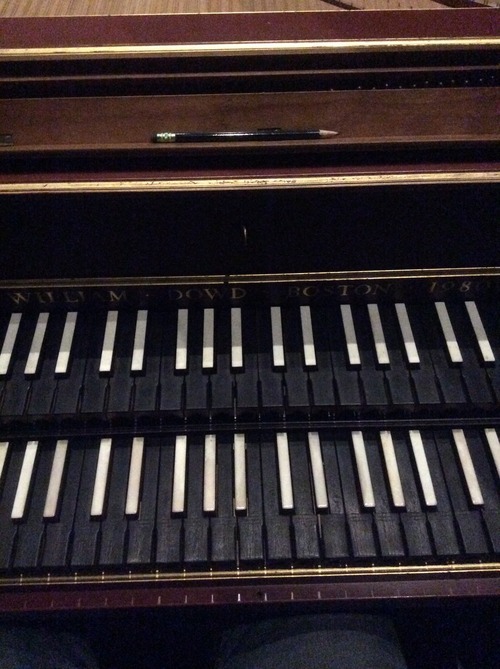
The basic set of options. (Secondary bullet L/R indicates the setting, either right or left.)
- Left stop:
- L: bottom manual 8' off
- R: bottom manual 8' on
- Middle stop: lute stop
- L: lute stop on
- R: lute stop off
- Right stop
- L: bottom manual 4' off
- R: bottom manual 4' on
- Top manual
- Back: bottom manual locks/activates both manuals
- Forward: bottom manual unlocked
- 3 timbres consisting of 1 string set
- 3 timbres consisting of 2 string sets
- 1 timbre combining all three sets.
- 7 total timbre possibilities.
For instance, the top manual could use just the "front 8" (one of two sets of 8-foot strings) While the bottom could use the "back 8" plus the 4-foot set. That's just one of a number of possibilities. Note that there are limits. For instance, this harpsichord is not capable of giving additional options to the upper manual. This is presumably because the top manual is the "contrast manual", used to set off against the colors set up by the lower manual.
Here is a photo of the instrument:
Thursday, March 6, 2014

Wednesday, February 26, 2014
Microsoft Web Embeds
My affinity for embeds leads me to try out virtually every example I can get my hands on. A while back, Microsoft started offering web embeds for office online documents and they have improved the design over time. I just want to see what advantages, if any, Microsoft offers over Google Docs on the embed side. Let's have a look:

What do you think?
Learned Detachment
I think that one of the reasons I struggle academically is that I get genuinely interested and invested in a given topic in a reading. And it makes me want to read up on any number of branching topics that get brought up. I want to ingest tables of useful information and investigate references, similar to the way we all do when occasionally getting lost down the never-ending wiki-rabbit hole.
But there really isn't time for that kind of exploration when you're in school. You kind of need to be detached and indifferent about what you're reading, because there is far too much to read to have the time to get interested and far too much to do to have time to write the thoughtful papers we may have inside us. It's a shame, because the whole point of being a student is growth and mentored investigation. It's a paradox, because the same structured learning environment both creates and poisons that energy. I hope one day we figure out a better way!

Sunday, February 23, 2014
Composer Network

Tuesday, January 28, 2014
Tuesday, January 7, 2014


Monday, December 16, 2013
||: Music is Hard :||
The daily rags feel compelled to print none but the most well-worn tropes about contemporary classical music. Boldly going where all have gone before. By the time something interesting is being said, the audience has moved on. Why not skip the "contemporary music is hard" bit and go straight to talking about how great the festival is? It's only hard if you say it's hard.
I mean no disrespect to Ms. Kelly when I say that it really is a severe waste of column inches to drone on and on about the ways in which audiences are so easily turned off to classical music, contemporary or otherwise.
In fairness:
...I think we probably agree about most points, but when are we going to start talking about just how great the 20th century is? It's the world's greatest cornucopia of art. Every possible kind and variety of sound has been explored since the year 1900. One of the many problems is that we still try to lump them all together and sell them together. Corporate types love to talk about "unbundling". When will we start to see unbundling in the music world?
The truth is, this has been taking place for sometime, with things like the American Mavericks festival a few years back. But we need more. We need festivals, artists, presenters, and ensembles committing themselves to concerts and series and festivals devoted to only a handful of great works from specific 20th century genre. It's important to remember that the contemporary art music sphere has exhibited far more biodiversity in the 20th century than has the popular music world. Yet one would ordinarily bristle at the thought of mixing Benny Goodman and Tupac in one music event. True, classical music has a fan culture with more eclectic tastes. But the point is that we want to grow audiences. And some audiences want specific things and don't want other things. So let's be more considerate of their tastes when we design concert programs.
In fairness:
With all due respect, the only failure of 20th c. music is failure of imagination on the part of we, the performers.
— Jordan Randall Smith (@jordanconductor) December 5, 2013
...I think we probably agree about most points, but when are we going to start talking about just how great the 20th century is? It's the world's greatest cornucopia of art. Every possible kind and variety of sound has been explored since the year 1900. One of the many problems is that we still try to lump them all together and sell them together. Corporate types love to talk about "unbundling". When will we start to see unbundling in the music world?
The truth is, this has been taking place for sometime, with things like the American Mavericks festival a few years back. But we need more. We need festivals, artists, presenters, and ensembles committing themselves to concerts and series and festivals devoted to only a handful of great works from specific 20th century genre. It's important to remember that the contemporary art music sphere has exhibited far more biodiversity in the 20th century than has the popular music world. Yet one would ordinarily bristle at the thought of mixing Benny Goodman and Tupac in one music event. True, classical music has a fan culture with more eclectic tastes. But the point is that we want to grow audiences. And some audiences want specific things and don't want other things. So let's be more considerate of their tastes when we design concert programs.
 |
Alex Ross, author of The Rest is Noise, which was the spur to the Southbank Centre festival (Picture: BBC Archives)
|
Saturday, December 14, 2013
Hogwood at Cornell
The Past Is a Foreign Country: Why Making Music Matters
Hogwood speaks at Cornell University
Hogwood speaks at Cornell University
From the site:
"Understanding the musicality of the past can enrich the musical life of the present," said conductor, musicologist and keyboard player Christopher Hogwood Oct. 25, 2013 during his first visit to campus as an A.D. White Professor-at-Large at Cornell University.
"Understanding the musicality of the past can enrich the musical life of the present," said conductor, musicologist and keyboard player Christopher Hogwood Oct. 25, 2013 during his first visit to campus as an A.D. White Professor-at-Large at Cornell University.
Now, with more than a century's worth of recorded evidence of how music was heard in the past, said Hogwood, people are able to pursue a historical interest in music, and the music of the 19th and 20th centuries can be observed and judged by everyone -- not just expert musicians or historians.
Learn more at the Cornell University website.

Subscribe to:
Posts (Atom)